When Joyce observed the team at Cazam Kitchens, she had a chance to see cabinet making and joinery up close and consider whether it was the pathway she wanted to pursue.
The Building & Construction Foundation arranged that workplace shadowing through our Building Women’s Careers program. The experience helped Joyce confirm her direction, and she is now progressing to a joinery pre-apprenticeship. Our support continues through material assistance to help remove barriers around her next step in training. [3]
Her experience is one example of the difference support can make when it follows a person’s goals and circumstances.
Jobs and Skills Australia’s Pathways to Success: Jobs and Skills Report 2026 examines how people move through education and work, develop their skills and find opportunities to use them. Those questions connect closely with work the Foundation is doing across construction pathways. [1]
Helping people continue their training
For an apprentice, the costs around learning a trade can compete with everyday living expenses. Course fees, tools, PPE and transport can all put pressure on someone who is working and studying.
Cody Hunter is developing his cabinet-making skills through an apprenticeship, with training at Melbourne Polytechnic. Our Early Career Scholarship has helped ease cost-of-living pressures and cover his TAFE fees. We continue to support him as he progresses through his apprenticeship. [3]
JSA identifies time and cost as barriers to participation in education and training. Our scholarship and practical assistance work responds to the costs and circumstances affecting the individual. That can make a training commitment more manageable and help someone keep working towards their qualification. [1, 4]
Our support extends beyond financial assistance. Depending on individual needs, we can connect people with mentoring, coaching, tutoring and academic help, advocate with schools or training providers, and make referrals to other organisations. Working with the broader support community helps build further layers of assistance around the person.
Turning an industry connection into an opportunity
Entering a trade as a mature-age woman, Ailish had completed her Certificate II in Electrotechnology and knew she wanted to become an electrician. Through our Building Women’s Careers program, we reached into our Trade Network and found an apprenticeship opportunity with Harris HMC. We funded additional training, tools and fuel assistance to help her secure and take up the role. She says the support made the industry far more accessible to her. [3]
Josephine, also a participant in our Building Women’s Careers program, needed guidance to explore which construction pathway suited her transferable skills and interests. We funded additional training and practical financial assistance, then connected her with a Safety Officer traineeship with Hickory. [3]
Our involvement made those employer connections possible. The different pathways show how support can respond to someone’s starting point, whether they need help to secure an opportunity or guidance to choose a direction.
Through our Building Women’s Careers program, we have supported 40+ women. We provide assistance around individual goals and barriers, including training, tools, guidance and employer connections. Our Building Women’s Careers program is delivered by the Building & Construction Foundation. We collaborate with Incolink’s Women in Construction project, with funding from the Australian Government Department of Employment and Workplace Relations. [5]
Supporting qualifications across construction
Construction careers develop through a range of learning pathways. Our scholarship work includes pre-apprenticeships, trade qualifications, training tickets and construction-related diplomas and degrees.
Our Early Career Scholarship, awarded through our partnership with The Gordon, helped Ash complete his carpentry apprenticeship. He qualified, progressed to a leading-hand role and set his sights on further study in Building & Construction. [3]
Niloo migrated from Iran to Australia to pursue new opportunities, adjusting to a new language and community along the way. A scholarship funded by the Foundation through our Building and Construction Hardship and Wellbeing scholarship collaboration with Holmesglen helped her complete her Diploma in Building & Construction. She found a sense of belonging in her learning community and shared her knowledge with fellow students. [3]
Ahmed Hassan brought more than a decade of construction experience from overseas, but faced barriers to finding industry work in Australia. Our Mario Biasin Legacy scholarship, awarded in 2025, supports his master’s at Deakin University, adding Australian industry knowledge to his existing experience. The profile created by his award and the Foundation’s network connected him with Hickory. The team recognised his value and brought him on board. He is now flourishing in his role while completing his master’s, and Hickory has gained an experienced colleague. His progress shows the value of advocacy, further learning and employers willing to recognise what someone can contribute. [3]
These experiences show the breadth of construction pathways and the value of help that enables people facing financial hardship and other barriers to pursue and complete their learning.
Giving young people a chance to understand their options
Choosing a pathway is easier when a young person has had the chance to see what the work involves, try an activity and speak to someone doing it.
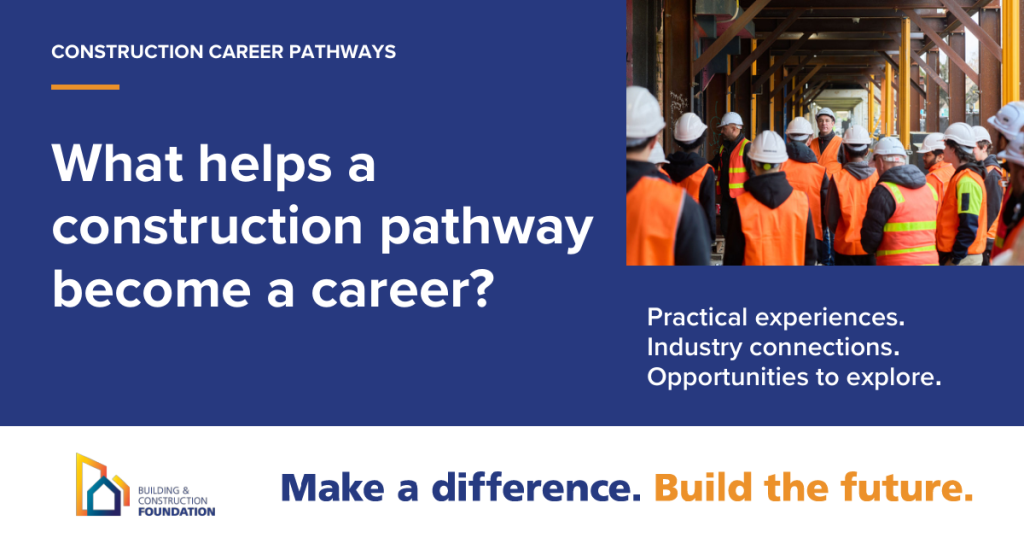
Our Youth Industry Immersion program brought those opportunities together for 38 students across two separate cohorts in 2026. Each cohort completed a three-day program, with one cohort in each of two weeks. We coordinated trade activities, workplace visits and industry conversations so students had time to explore and ask questions. [3]
The program connected students with people across trades and project delivery. In rotating conversations, contributors shared their roles, career pathways, experience and insights. Students also saw innovation and modern methods of construction, giving them a view of the industry today and where it is heading. We delivered the program with Melbourne Polytechnic and INLLEN School to Work, with workplace hosts SYNC and Hickory.
Some participants have since undertaken further work experience with program partners. Students have also contacted the Foundation for additional support towards an apprenticeship pathway. We are keeping those connections open and helping with the steps that can follow an initial experience. [3]
JSA’s report highlights the need to help new labour-market entrants navigate education and training pathways into work. Our contribution is to make construction pathways more visible and easier to explore through practical industry access and follow-up support. [1]
OECD research on teenage career preparation also highlights the value of meaningful contact with employers and people in work, and finds that too few young people have access to those experiences. Our immersion program responds through workplace exposure and conversations across the sector. [6]
We need funding partners to meet the delivery costs of future program cycles. Employers can host site visits, mobilise their project teams and subcontractors to share their work, or contribute to industry conversations. Those connections can also open doors to further work experience, cadetships, apprenticeships and employment.
Paying attention to the experience of learning and work
The quality of an apprenticeship matters alongside access to it. NCVER’s Apprentice and trainee outcomes 2025 found that 27.7% of trade non-completers cited dissatisfaction with pay, working conditions or the workplace as their main reason for not completing. The survey was conducted in 2025 about training undertaken in 2024. [2]
Employers, supervisors and mentors have an opportunity to nurture the next generation, share their craft and see someone grow in confidence and capability. Good supervision, safe conditions, useful feedback and time for questions all contribute. Learning flows both ways, with apprentices bringing their own ideas and perspectives.
The Foundation works alongside that workplace learning. We coordinate support around individual needs, ease financial pressures, make useful connections and collaborate with educators and other support organisations. Together, we have more ways to notice when someone needs help and support their next step.
A community making the next step possible
Across our work, with figures current at September 2026, the Foundation has supported 400+ people across 30+ areas of study, with $800K+ awarded in scholarships and program support. [4]
People come to us with different backgrounds and circumstances. Financial hardship can sit alongside gender barriers, caring or sole-parenting responsibilities, family violence, housing instability, disability or health pressures, regional access, disrupted education, language barriers or limited industry networks. Our work includes First Nations people and people from culturally and linguistically diverse, refugee and migrant backgrounds. Support is shaped around the person and what they are working towards.
Australian Institute of Family Studies research on young Australians shows that education and work often overlap, while health, experience and access to suitable jobs can shape participation. Its companion research highlights the financial pressures around education, work and housing, and differences in access to family support. These findings reinforce the value of assistance that responds to the person’s circumstances as their pathway develops. [7, 8]
The stories in our Impact & Vision report show what that support has helped people do: confirm a pathway, meet training costs, take up work, complete a qualification or continue developing their skills.
Our Trade Network brings together people and organisations willing to contribute employment, structured work experience, mentoring, specialist expertise, tools and other practical support.
The opportunities in these stories rely on people and organisations willing to contribute. Our Support and Partnership Prospectus outlines ways to help fund scholarships and program delivery, alongside the industry connections and practical support described here. To discuss how you could be involved, contact Sara Abraham, Executive Director.
Sources
- Jobs and Skills Australia, Pathways to Success: Jobs and Skills Report 2026, pp. 38, 41–44, 63 and 78–79. © Commonwealth of Australia.
- NCVER, Apprentice and trainee outcomes 2025, published 25 March 2026. Survey collected June–August 2025 about training undertaken during 2024.
- Building & Construction Foundation participant and employer accounts: Cody Hunter, Joyce and Cazam Kitchens, Ailish and Harris HMC, Josephine, Ash, Niloo, Ahmed Hassan and Youth Industry Immersion; current Foundation follow-up supplied by Sara Abraham and Foundation scholarship recipient-history records.
- Building & Construction Foundation impact reporting, figures current at September 2026. Our published Impact & Vision report is available through the Downloads page.
- Building & Construction Foundation, Building Women’s Careers program reporting.
- OECD (2025), The State of Global Teenage Career Preparation. International research on career guidance and employer engagement; published 20 May 2025.
- Australian Institute of Family Studies, Spotlight: Young Australians’ employment and education, 26 August 2026. LSAC Wave 10, 2023–24.
- Australian Institute of Family Studies, Spotlight: Young Australians’ financial stress and financial support from parents, 26 August 2026. LSAC Wave 10, 2023–24.